.png)
Florida Dental Implant Institute Welcomes Dr. Rand, MD Oral Surgeon
With the addition of Dr. Rand, we become the only office in the Naples area with two dual-degree, MD-trained oral and maxillofacial surgeons.

Admin

May 2025
.png)


Losing a tooth, whether from decay, gum disease, or an accident, affects far more than just your smile. A missing tooth can change the way you chew, speak, and even the way your face ages over time. For many patients exploring tooth replacement options, the conversation usually comes down to two options: dental bridges and dental implants.
Both can restore appearance and function, but they work in very different ways, and those differences matter long term. This guide breaks down how bridges and implants compare, including how they’re placed, how long they last, how they affect surrounding teeth and bone, and which option may make the most sense depending on your goals.
A dental bridge and a dental implant both replace missing teeth, but they work differently. A bridge relies on neighboring teeth for support and does not replace the tooth root, which can allow jawbone loss over time. A dental implant replaces the entire tooth, including the root, integrates with the jawbone, preserves bone density, and typically lasts much longer. While bridges cost less upfront, implants often provide better long-term value and oral health benefits.
Dental bridges and implants both replace missing teeth, but they do so using completely different approaches.
Understanding that distinction is key to understanding their long-term impact on your oral health.
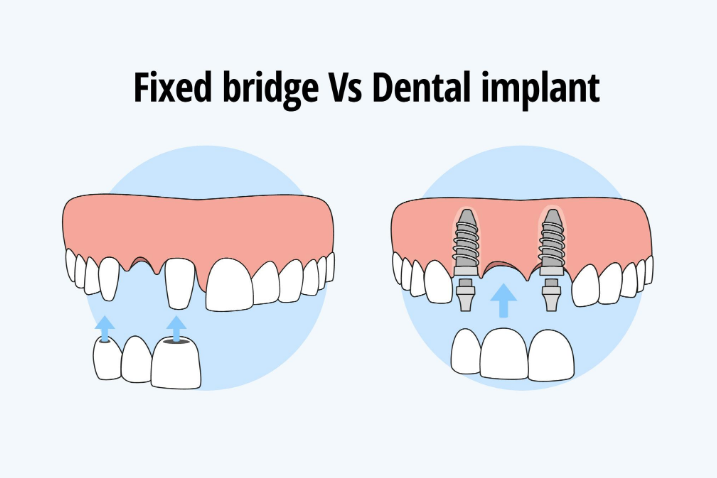
A dental bridge quite literally “bridges” the gap left by a missing tooth. It is made up of:
To place a bridge, the adjacent teeth must be permanently reshaped to support crowns. Once prepared, impressions are taken and a custom restoration, typically porcelain, zirconia, or porcelain-fused-to-metal, is fabricated and cemented in place.
Because a bridge rests on top of the gums, it restores function above the gumline but does not replace the tooth root beneath the surface.
Important to know: Without a tooth root or implant to stimulate the jawbone, bone loss can begin soon after tooth loss, sometimes up to 25% within the first year.
Bridges can be reliable and functional, especially when neighboring teeth already require crowns, but they do not prevent bone loss in the missing tooth area.
Dental implants are designed to replace the entire tooth structure, not just the visible portion.
The process begins with the placement of a small titanium post into the jawbone. Titanium is biocompatible and encourages the bone to grow around it through a process called osseointegration, forming a stable foundation similar to a natural tooth root.
Once healed:
The result is a replacement tooth that looks, feels, and functions like a natural one.
Unlike bridges, implants:
Help maintain facial structure over time
From a long-term health perspective, implants are often considered the most complete tooth replacement option. They restore strength, preserve bone, and avoid placing stress on neighboring teeth.
For patients planning long-term, especially those focused on durability, comfort, and facial support, implants are frequently the preferred choice among dental specialists.
Did you know? The first modern dental implants were placed in 1965, and the original patient kept them for over 40 years.
Dental bridges usually cost less upfront and require fewer visits. However, they often need replacement over time due to wear, decay of supporting teeth, or gum changes.
Dental implants involve a higher initial investment, but because they are designed to last decades, they often provide greater long-term value, especially when replacement costs are considered.
For many patients, implants align well with long-term health planning rather than repeat dental work.
The right choice depends on:
If your goal is to replicate a natural tooth as closely as possible, functionally and structurally, implants typically offer the closest match. That said, bridges can still be the right solution in specific circumstances.
The most important step is a comprehensive evaluation and an honest conversation about your options.
There’s no one-size-fits-all answer, just the solution that best supports your comfort, confidence, and future.
At the Florida Dental Implant Institute, we specialize in dental implants and complex tooth replacement cases. Our team focuses on long-term solutions that protect bone health, restore confidence, and deliver predictable results.
If you’re considering a dental implant or want an expert opinion on whether a bridge or implant is right for you, we’re here to help. Every consultation is focused on education, transparency, and building a treatment plan that fits your goals, without pressure.
Schedule a consultation to explore your options and take the next step toward a stable, confident smile.


%20(2).svg)
The Florida Dental Implant Institute is a specialized dental center that exclusively deals with dental implants and oral surgery. Our team has over 50 years of experience providing solutions for complex restorations and implant dentistry, ensuring that every step of the process is handled with perfection and care. Proudly serving the communities of Naples, Marco Island, Bonita Springs, Fort Myers, Cape Coral, and Lehigh Acres.