

What Are All-On-4 Dental Implants
All-on-4 Dental Implants can replace a full arch of teeth, using just four implants.

Admin

Jan 2024
.png)


If you follow online dental implant communities, you’ve likely noticed increasing interest in FP1 dental implants. Patients are realizing that the traditional All-on-4 approach is not the only option and may not be the best.
The top concern we hear from patients researching options is: “I don’t want fake gums or a thick, bulky bridge. I want something that looks and feels like real teeth.”
FP1 dental implants provide precisely that. At the Florida Dental Implant Institute in Naples, FL, we specialize in FP1 implants and Specialty Dental Medicine.
From day one, the Florida Dental Implant Institute has operated as a bone-conservation practice guided by our 4B approach: Bespoke, Bone, Bite, and Body. Every treatment plan is custom-built to protect your bone, optimize your bite, and deliver a result that is designed specifically around your anatomy—not a one-size-fits-all solution.
FP1 dental implants are a full-arch restoration classified under the Misch prosthodontic scale, where “FP” stands for “fixed prosthesis” and “1” refers to the highest level of natural appearance. In an FP1 restoration, only the teeth are replaced and your natural gum tissue is fully preserved.
This differs from the more common FP3 classification, which replaces both teeth and gum tissue with artificial materials like acrylic or zirconia. FP3 includes most All-on-4 and All-on-X procedures advertised by general dentists.
FP1 follows a different approach by preserving your natural gums instead of replacing them. Individual crowns and bridges, designed to match your natural teeth, are secured directly to implants in the jawbone. This creates a sleek, tooth-only appearance without bulky acrylic, artificial gum tissue, or oversized bridges.
In other words, your natural gums remain intact, resulting in a thinner, lighter, and more natural-looking smile that is indistinguishable from real teeth.
FP1 dental implants differ from traditional All-on-4 implants in one key way: FP1 fully preserves natural gum tissue, while traditional All-on-4 replaces it with pink acrylic or zirconia prosthetics. This difference affects all other aspects. FP1 restorations are thinner, lighter, and feel more natural, with no bulk, food trapping, or artificial gumline. Traditional All-on-4 often requires removal of healthy bone and tissue to fit the bridge, whereas FP1 is designed to preserve bone. However, FP1 requires even greater surgical skill and advanced training, which most implant surgeons do not offer. For eligible patients, FP1 provides a lifelike smile that promotes better long-term bone health and implant durability.
Below is a direct comparison of FP1 dental implants and the traditional All-on-4 (FP3) approach:
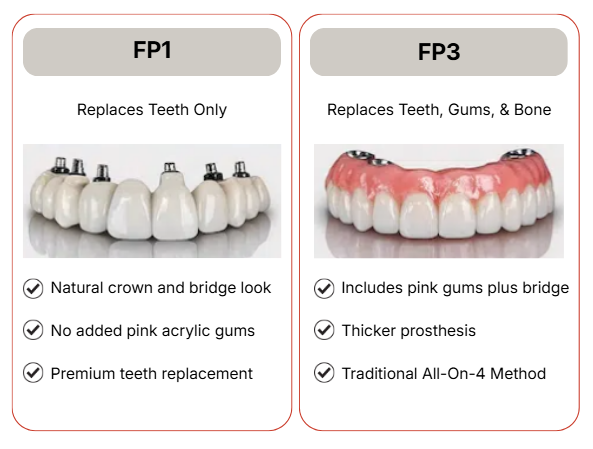
FP1 dental implants are rare because they demand more training, surgical precision, and clinical skill than standard All-on-4 FP3 procedures. Surgeons must complete rigorous postgraduate education in advanced implant surgery, occlusion, and prosthetic design beyond typical dental training.
FP1 also demands a mindset focused on patient-centered care rather than convenience. At the Florida Dental Implant Institute, this commitment guides our practice. Dr. Eberle’s dual board certifications in oral and maxillofacial surgery place him among a select group qualified to deliver authentic FP1 results.
FP1 requires extra chair time, appointments, and advanced lab work, making it a premium service often priced accordingly. At the Florida Dental Implant Institute, we believe this care should be accessible and affordable. We are committed to offering FP1 results at a price reflecting true value because the best smile solution should not be limited to those with the deepest pockets.
When evaluating providers for FP1 dental implants, ask these four questions:
FP1 treatment at the Florida Dental Implant Institute starts with a comprehensive and complimentary consultation. Our specialty team assesses your oral health, bone structure, and facial profile. We use advanced 3D imaging and digital planning to create a personalized approach tailored to your anatomy and smile goals.
On your procedure day, implants are placed into the jawbone under sedation. Unlike All-on-4, FP1 avoids aggressive bone reduction, preserving more of your natural anatomy and bone. Within 24 hours, you receive a secure, custom interim FP1 bridge that provides immediate comfort, function, and esthetics as your implants integrate.
After healing, your final custom zirconia FP1 restoration is placed, offering lasting strength, lifelike beauty, and durability. From consultation to final delivery, the process is smooth, personalized, and truly life-changing.
The discussion about dental implants is evolving. Patients are increasingly informed and expect improved esthetics, comfort, and long-term results. FP1 dental implants meet these demands.
At the Florida Dental Implant Institute in Naples, FL, we are proud to be at the forefront of this shift. If you are tired of being told that a thick, bulky bridge with fake gums is your only option—it is not. There is a better way, and we would love to show you what is possible.
Schedule your complimentary FP1 consultation today to learn why patients prefer tooth-only smiles that look, feel, and function naturally. Not only do we see patients in Naples and Fort Myers, but we also have patients who fly accross the country and world to visit our FP1 dental implant experts.
These are some of the most common questions we receive from patients researching FP1 dental implants. Each answer is self-contained for easy reference.
What does FP1 mean in dental implants?
FP1 stands for “Fixed Prosthesis 1” on the Misch prosthodontic classification scale. It denotes a full-arch dental implant restoration that replaces only the tooth crowns while preserving the patient’s natural gum tissue. No pink acrylic or artificial gumline is used. FP1 is considered the gold standard for natural appearance in full-arch implant dentistry.
What is the difference between FP1 and All-on-4?
All-on-4 is an FP3 restoration—it replaces both teeth and gums using a fixed bridge with artificial pink acrylic or zirconia gum tissue. FP1 replaces only the teeth, preserving the patient’s natural gum tissue. FP1 is thinner, lighter, more natural in appearance, easier to clean, and does not require the bone reduction that All-on-4 often demands. It also requires greater surgical skill and more advanced training to deliver correctly.
Is FP1 better than All-on-4?
For patients with sufficient bone volume and healthy gum tissue, FP1 offers a superior esthetic outcome. It preserves natural tissue, avoids the bulk of a full bridge, and produces results indistinguishable from natural teeth. However, FP1 is not suitable for everyone as it requires adequate bone and tissue to support a tooth-only restoration. A consultation with a qualified implant surgeon is the best way to determine candidacy.
Why do so few dentists offer FP1?
FP1 demands significantly more surgical training, clinical precision, and advanced prosthetic planning than FP3 or All-on-4 procedures. It is also more time-intensive and requires specialized laboratory work. Most general dentists and many implant-focused practices lack the postgraduate training needed to deliver a true FP1 outcome. Surgeons offering FP1 typically hold advanced board certifications in oral and maxillofacial surgery or implant dentistry.
Does FP1 require bone grafting?
FP1 is a bone-preserving procedure designed to work with your existing bone structure rather than requiring significant bone removal. However, patients with insufficient bone density may need grafting before or during implant placement. This is assessed during consultation and planning using 3D imaging.
How much do FP1 dental implants cost?
FP1 dental implants are a premium procedure due to the advanced surgical skill, multiple appointments, and specialized laboratory work required. Costs vary based on implant number, case complexity, and provider experience. At the Florida Dental Implant Institute, we are committed to making FP1 accessible and affordable. Contact us for a complimentary consultation and personalized treatment estimate.
Where can I get FP1 dental implants in Naples, Florida?
The Florida Dental Implant Institute in Naples, FL specializes in FP1 full-arch implant restorations under the care of Dr. Nathan Eberle, a dual board-certified oral and maxillofacial surgeon. Our office also operates as a bone-conservation practice using the 4B approach—Bespoke, Bone, Bite, and Body, to deliver individualized, natural-looking implant results. Complimentary consultations are available.


%20(2).svg)
The Florida Dental Implant Institute is a specialized dental center that exclusively deals with dental implants and oral surgery. Our team has over 50 years of experience providing solutions for complex restorations and implant dentistry, ensuring that every step of the process is handled with perfection and care. Proudly serving the communities of Naples, Marco Island, Bonita Springs, Fort Myers, Cape Coral, and Lehigh Acres.
.webp)


