

AI, ChatGPT, and Its Role in Clinical Decision Making
Hear our perspective on whether we can trust AI and ChatGPT when it comes to clinical decision-making in dentistry.

Admin

May 2023
.png)


If you're searching "how much are dental implants," you're not alone. It's one of the most common questions we hear from patients every day. This guide breaks down the real costs, what's included (and what's hidden), and how to make sure you're getting the best value for a smile that lasts a lifetime.
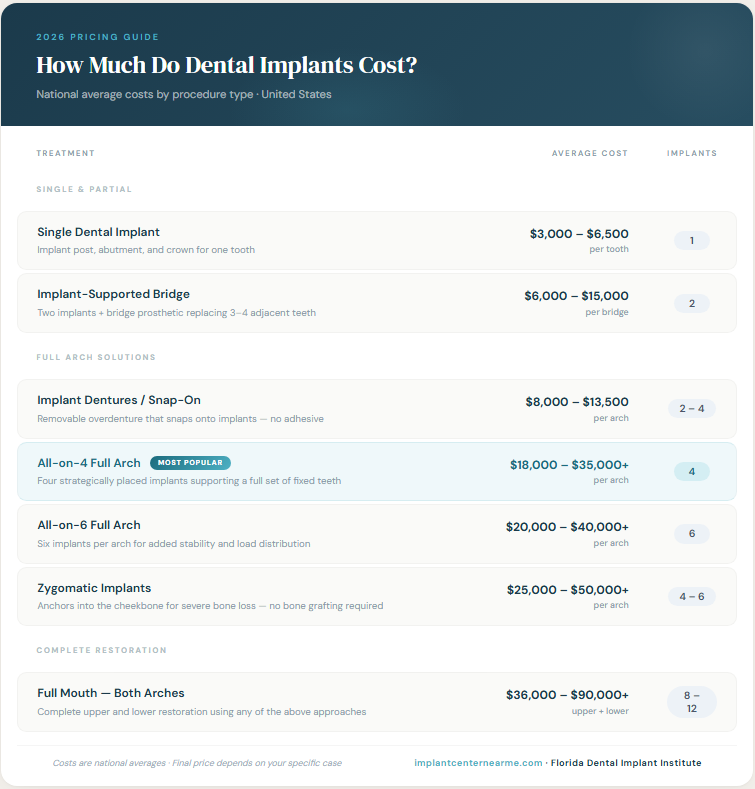
Here's a straightforward breakdown of dental implant costs in the United States in 2026:
Important: These are national averages. Your actual cost depends on your specific case, location, materials, and the experience level of your surgeon. Beware of quotes that seem unusually low — they often exclude critical components like the abutment, crown, imaging, or sedation.
A dental implant isn't a single piece — it's a three-part system designed to replicate the structure and function of a natural tooth:
When evaluating quotes, make sure all three components are included. Many practices advertise only the cost of the implant post to make prices look lower, then add significant charges for the abutment and crown later.
The wide range of dental implant pricing comes down to several key factors:
Number of Teeth Being Replaced: Replacing a single tooth costs significantly less than replacing an entire arch. Full-mouth restorations require more implants, more materials, and more surgical time.
Type of Implant Procedure: Different procedures carry different costs. All-on-4 uses four strategically angled implants to support a full arch and is generally less expensive than placing 6–8 individual implants. Zygomatic implants — which anchor into the cheekbone rather than the jawbone — are more complex but allow patients with severe bone loss to receive permanent teeth without bone grafting.
Material Quality: The material used for your final teeth makes a significant difference in both cost and longevity. Acrylic (PMMA) prosthetics are less expensive but typically need replacement within 5–10 years. Zirconia is more durable, stain-resistant, and natural-looking, and can last 20+ years with proper care.
Surgeon Credentials and Experience: There's a meaningful difference between having dental implant surgery performed by a general dentist, an oral surgeon (DMD/DDS), or an MD oral surgeon with medical and dental training. More experienced surgeons in specialized implant practices may charge more, but the investment often pays off in higher success rates, fewer complications, and better long-term outcomes.
Pre-Surgical Procedures: Some patients require additional work before implants can be placed. Tooth extractions typically add $150 to $650 per tooth. Bone grafting adds $500 to $3,000. Sinus lifts add $1,500 to $5,000. Treatment for gum disease varies. These procedures are critical for implant success and should be factored into your total cost.
Sedation and Anesthesia: Options range from local anesthesia (included in most quotes) to IV sedation or general anesthesia, which can add $500 to $2,000 depending on the provider and whether anesthesia is handled in-house or outsourced.
Geographic Location: Dental implant costs vary significantly by region. Major metropolitan areas and coastal states tend to be higher, while practices in the Southeast and Midwest are often more competitively priced.
Technology and Imaging: Practices using 3D CT imaging, digital surgical guides, and CAD/CAM milling for same-day prosthetics may charge more, but these technologies improve precision, reduce complications, and often speed up the overall treatment timeline.
Understanding how dental implants compare to alternatives helps put the cost in perspective:
Dental Implants (Zirconia): $3,000 to $6,500 per tooth. Lasts 20–30+ years. Preserves jawbone. Estimated 20-year cost: $3,000 to $6,500 (one-time investment).
Dental Bridge: $2,000 to $5,000. Lasts 7–15 years. Does not preserve bone. Requires grinding down healthy adjacent teeth. Estimated 20-year cost: $4,000 to $10,000+ (with at least one replacement).
Traditional Dentures: $1,000 to $3,000 per arch. Lasts 5–8 years. Does not preserve bone- actually accelerates bone loss. Requires adhesive. Estimated 20-year cost: $3,000 to $9,000+ (with multiple replacements and relines).
Doing Nothing: $0 upfront. Missing teeth cause bone loss, shifting of remaining teeth, bite changes, difficulty eating, and further decay. The long-term cost of doing nothing is often the most expensive option of all.
Dental implants have a higher upfront cost, but they are typically the most cost-effective solution over a lifetime because they don't require replacement every few years, they preserve jawbone density, and they prevent the cascading dental problems that come with missing teeth.
Full mouth dental implant costs vary based on the approach:
All-on-4 Dental Implants: The All-on-4 protocol uses four implants per arch to support a full set of fixed teeth. This is one of the most popular full-arch solutions because it minimizes the number of implants needed and often eliminates the need for bone grafting. Cost ranges from $18,000 to $35,000 per arch, or $36,000 to $70,000 for both arches.
All-on-6 Dental Implants: Similar to All-on-4 but with six implants per arch for added stability and load distribution. This approach is often preferred for the upper jaw or for patients who grind their teeth. Cost ranges from $20,000 to $40,000 per arch.
Zygomatic Dental Implants: For patients who have been told they don't have enough bone for traditional implants, zygomatic implants offer a solution without bone grafting. These longer implants anchor into the dense zygomatic (cheek) bone. Not all practices offer this procedure — it requires advanced surgical training. Cost ranges from $25,000 to $50,000+ per arch.
What Should Be Included in a Full-Arch Quote?: A comprehensive, all-inclusive quote for full-arch dental implants should cover the consultation and 3D imaging, all extractions, the implant surgery, sedation or anesthesia, a temporary prosthesis, the final prosthesis (ask specifically whether it's acrylic or zirconia), and all follow-up visits. If a practice doesn't include all of these in their quote, you could face thousands in surprise charges later.
Most dental insurance plans classify implants as an elective procedure, which limits coverage. However, here's what many patients don't realize:
Some plans will cover portions of the treatment, particularly extractions, the crown, or bone grafting, even if they won't cover the implant post itself. Annual maximums on most dental plans range from $1,000 to $2,000, which is a fraction of total implant costs. Medical insurance may cover implant surgery in certain situations, particularly if tooth loss resulted from an accident, trauma, or a medical condition. Many practices offer pre-treatment insurance verification to maximize your benefits.
Most implant practices offer financing to make treatment more accessible. Common options include third-party medical financing (like CareCredit or Proceed Finance), in-house payment plans, HSA and FSA funds, and dental discount plans. When comparing practices, ask about their financing terms- some offer 0% interest promotional periods.
Not all dental implant providers deliver the same results. Here's what to evaluate:
Surgeon credentials. Is your surgery being performed by a general dentist, an oral surgeon, or an MD oral surgeon like we use at the Florida Dental Implant Institute? More advanced training generally means better outcomes, especially for complex cases.
Case volume. How many implant procedures does the practice perform each month? High-volume implant centers develop the expertise that comes only with repetition.
Technology. Does the practice use 3D CT imaging, digital surgical planning, and in-house milling? These technologies improve precision and often reduce treatment time.
Material quality. What material is used for the final prosthesis? Zirconia is the gold standard for durability and aesthetics. Ask if you're getting zirconia or acrylic (PMMA).
Warranty. Does the practice offer a warranty on the implants and the prosthesis? A strong warranty demonstrates confidence in the work.
Timeline. Some practices require 6–12 months of treatment across many visits. Others can deliver permanent teeth in as little as one week. Understand the timeline before committing.
Before-and-after photos and reviews. Ask to see results from cases similar to yours or read the dental implant case studies if available. Read reviews from verified patients and check out the before and after photots.
A single dental implant, including the post, abutment, and crown, typically costs between $3,000 and $6,500 in the United States in 2026. Costs vary based on location, materials, and surgeon experience.
Full mouth dental implants range from $36,000 to $90,000+ for both arches, depending on the procedure type (All-on-4, All-on-6, or individual implants), materials, and whether additional procedures like bone grafting are needed.
For most patients, yes. Dental implants are the only tooth replacement option that preserves jawbone, prevents further bone loss, and can last a lifetime. When you factor in the long-term costs of replacing bridges or dentures every 5–15 years, implants are often the most cost-effective choice.
The cost reflects multiple components: a biocompatible titanium post, custom-manufactured abutment and crown, advanced 3D imaging, surgical expertise, sedation, and multiple appointments. You're paying for precision surgery and materials designed to last decades.
Many practices offer financing plans that allow you to begin treatment with little or no money down. Third-party lenders like CareCredit and Proceed Finance offer promotional 0% APR periods. Ask your implant provider about available options.
Original Medicare (Parts A and B) generally does not cover dental implants. Some Medicare Advantage (Part C) plans include dental benefits that may partially cover implants. Check with your specific plan for details.
Patients with insufficient bone have several options, including bone grafting, sinus lifts, or zygomatic implants. Zygomatic implants anchor into the cheekbone instead of the jawbone and can be placed without bone grafting — though this procedure requires a surgeon with specialized training.
The implant post itself can last a lifetime with proper care. The prosthesis (crown or full-arch restoration) may need replacement after 10–20+ years depending on the material. Zirconia restorations tend to last longer than acrylic.
Most patients report that dental implant surgery is less painful than they expected. The procedure is performed under local anesthesia or sedation, and post-operative discomfort is typically managed with over-the-counter pain medication. Most patients return to normal activities within a few days.
Traditional implant placement involves a 3–6 month healing period after surgery before the final crown is placed. However, some practices offer accelerated protocols that deliver permanent teeth in as little as one week using immediate-load implant techniques.
The only way to know exactly how much dental implants will cost for your specific situation is to schedule a consultation with an experienced implant provider. During a consultation, you should receive a comprehensive oral exam with 3D imaging, a personalized treatment plan, a clear all-inclusive cost estimate, a review of financing options, and answers to all your questions.
Florida Dental Implant Institute specializes exclusively in dental implant surgery, performed by MD oral surgeons with both medical and dental degrees. We handle the most complex cases — including patients who've been told they're not candidates for implants — and deliver permanent zirconia teeth in as little as one week.
Schedule your free consultation today to get a personalized cost estimate and learn about your options.


%20(2).svg)
The Florida Dental Implant Institute is a specialized dental center that exclusively deals with dental implants and oral surgery. Our team has over 50 years of experience providing solutions for complex restorations and implant dentistry, ensuring that every step of the process is handled with perfection and care. Proudly serving the communities of Naples, Marco Island, Bonita Springs, Fort Myers, Cape Coral, and Lehigh Acres.

.webp)

